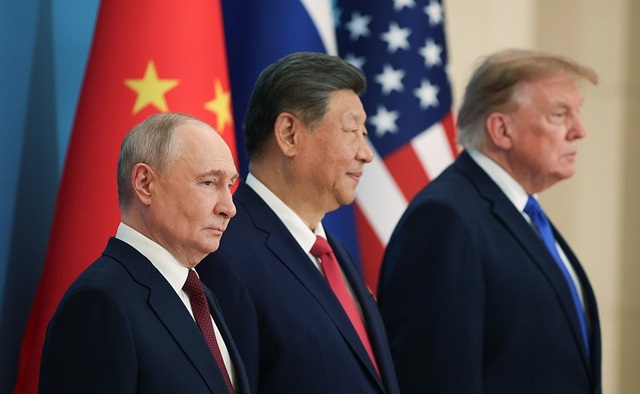
The first trilateral meeting of representatives from China, Russia and the United States is an event whose significance extends beyond the specific topics that may be on the agenda. The very format of the meeting, in fact, conveys a certain political message. These three states, which possess extraordinary economic, military, and geopolitical power and are also permanent members of the UN Security Council, present themselves here as actors with a special responsibility for international peace and security. This is not, however, about the formation of a new alliance or the confirmation of a common geopolitical bloc. What is more significant is the attempt to create a common language in which these three powers can communicate and negotiate the shape of the international order, despite their differing interests and visions of how it should function.
It is precisely in this that the main political significance of the meeting lies. The speeches by Xi Jinping, Vladimir Putin and Donald Trump show that, whilst there are significant differences between the three countries in their understanding of international politics, there is also a relatively broad scope for common ground. All three leaders speak of the responsibility of great powers, the need for dialogue, stability and a safer world. However, each of them attaches a slightly different meaning to these concepts. This common language should therefore not be confused with a convergence of foreign policy concepts. Rather, it is a prerequisite for differing concepts to be able to come together at a single negotiating table.
From a historical alliance to the current responsibilities of great powers
Xi and Putin have drawn on the historical experience of the Second World War as a symbolic foundation for their current cooperation. Xi Jinping recalls the shared victory of the anti-fascist coalition; Putin refers to the founding of the UN, which all three states supported; whilst Trump emphasises above all the historical significance of the meeting itself and made no mention of the Second World War.
This reference creates continuity between the post-war order and the notion of the three superpowers’ special responsibility, whilst also legitimising their privileged position. It is also the strongest common thread running through the speeches: Xi Jinping speaks of the responsibility of major states in the ‘global village’, Putin of the shared responsibility for peace and security arising from their status as permanent members of the Security Council, and Trump of the duty of the greatest superpowers to maintain an open dialogue.
What they have in common, therefore, is the conviction that international stability depends primarily on relations between the major powers. Universal institutions and rules remain part of the argument, but in all three cases the leading role is played by states with sufficient power to influence global affairs. In other words, China, Russia and the US see themselves as particularly privileged actors with powerful potential for influence. The power matters.
Three different visions of the international order
However, such similar phrasing masks differences in the understanding of the nature and purpose of cooperation. Chinese leader Xi Jinping emphasises stability and predictability. He speaks of strategic stability in relations between major powers, peaceful coexistence, and balanced development and cooperation among major powers as necessities: confrontation leads to chaos, whilst good relations lead to a safer environment. In his view, the world has no other alternative. In doing so, he distinguishes between Russia, with which he has a comprehensive partnership and strategic interaction in this new era, and the US, with which he wishes to build constructive and stable strategic relations. China is thus not entering the framework as a player declaring an equal partnership with both, and is retaining scope for strategic autonomy. At the same time, it is becoming apparent that the two countries – and cooperation with them – are perceived differently.
Putin’s argument is more institutional and legal in nature. He emphasises the preservation and strengthening of international law, particularly the UN Charter; he builds on the Russian concept of multipolarity, which rejects the privileged status of any single power; and he places emphasis on mutual respect, equality and a balance of interests. Russia thus presents itself as an integral part of the international system with the right to participate in decision-making on security; it links the defence of international law with the defence of equality among powers. On all these points, both Putin and Russian diplomacy are highly consistent.
US President Trump has focused on practical results and direct dialogue between the major powers. In his view, disagreements are no reason to break off communication; on the contrary, it is precisely through negotiation that differences should be overcome. This represents a commitment to traditional diplomacy, which entails communication amidst disagreements. This is most clearly illustrated by the proposal to open discussions on nuclear arms reduction amongst the three largest nuclear powers, although Trump admits that it is difficult to completely give up a nuclear arsenal. In his view, nuclear security is an area of mutual interest.
A difference is also evident in Trump’s criticism of the International Criminal Court: whilst Putin and Xi Jinping emphasise the UN and the institutional framework of the post-war order, Trump questions the legitimacy of certain supranational institutions, such as this very court. The joint statement on the responsibilities of the major powers, on which all three leaders agreed, thus encompasses differing views on institutions and rules.
A common language is not a common strategy
These differences show that it would be premature to interpret the meeting as a convergence of ideas. A common language does not imply agreement on the form of the international order, but rather sufficient scope for joint statements, communication and negotiation. Everyone can support peace, speak of stability and emphasise international law without agreeing on the conditions, threats or interpretation.
This is evident in the case of the war in Ukraine. Putin classifies it as one of the conflicts that the major powers should discuss; Trump confirms that he has spoken to Putin about it and hopes for its end. Xi Jinping makes no mention of it in his opening address, which does not mean that China is not paying attention to it, but rather that the emphasis differs and that, specifically, China is continuing to adhere to its official line of ‘neutrality’ regarding the conflict.
It is also significant that Ukraine is absent as a participant from the format itself: the framework of the talks is based on the notion that fundamental security issues should be discussed primarily by the major powers. The three states are thus not only seeking a common language, but also defining who has the decisive say in shaping the international order. This is rather significant information.
The significance of the trilateral format
The very fact that representatives of China, Russia and the United States are meeting in a trilateral format therefore carries its own political significance. This is not a routine diplomatic meeting between three states that share a number of common interests. It is a symbolic affirmation of their status as powers whose mutual relations are of fundamental importance to global security.
For China, this format is an opportunity to act as a mediator and as one of the main architects of the international order. Xi Jinping assumes the role of host and sets out a general framework designed to bridge the differences between Moscow and Washington. In doing so, Beijing does not need to declare that it favours one side over the other. On the contrary, its position is based precisely on the ability to maintain strategic relations with both powers, even though each of these relationships takes a different form.
For Russia, the trilateral format is significant in terms of its international standing. Here, Moscow does not merely appear as a party to the war in Ukraine or as a state whose relations with the West are strained by conflict. It is present as one of three powers whose cooperation is regarded as vital for global stability. This is in line with Russia’s efforts to promote a multipolar order in which the status of great powers is based on mutual recognition of their strategic interests.
For the United States, the meeting represents an opportunity to open direct dialogue with both powers and to seek concrete agreements in areas such as nuclear security or the war in Ukraine. Trump’s approach, however, is less focused on formulating a common doctrine and more on the possibility of achieving results through personal negotiation.
This format therefore does not necessarily imply – and most likely does not imply – that a new bloc is being formed between the three states. Its significance lies rather in the recognition that none of these powers can ignore the other two when addressing fundamental global issues. Mutual rivalry and differing interests have not disappeared, but alongside them there is scope for a certain form of coordination.
At the same time, this approach must also be recognised as problematic. If international stability is increasingly derived from agreements between the few most powerful states, smaller countries find themselves in a weaker position. Their security interests may become the subject of negotiations between the great powers, without them having a commensurate opportunity to influence the outcome. This problem is particularly evident in the context of Ukraine, but it also applies to other regional conflicts and security arrangements. This does not mean that cooperation between the great powers is in itself contrary to international law, or that their dialogue cannot contribute to reducing security risks. However, it highlights the tension between the great-power conception of stability and the principle of a universal international order in which states are formally equal.
Between rivalry and coordination
The three leaders’ speeches did not provide evidence of any fundamental geopolitical convergence. They showed that even among powers with differing interests and often conflicting visions of the international order, they still need a common diplomatic framework. Xi Jinping brings to this framework an emphasis on stability; Putin, on equality amongst great powers and a balance of interests; and Trump, on practical negotiation and the conclusion of concrete agreements.
These three approaches are not identical. Nor are they necessarily incompatible. This is precisely why a common language may be more important than any declaration of political unity. It enables negotiations to proceed in such a way that none of the actors has to abandon their own vision of the international order.
At the same time, however, it is clear that a certain vision of how international politics should be organised is being promoted here. It is based on the special responsibility of the major powers, which have not only the capacity but also the right and the duty to participate in resolving global problems. Such an approach reinforces the importance of great-power diplomacy and may open up scope for coordination on issues where the interests of the three states intersect. However, it does not in itself resolve conflicts between their interests, nor does it address the question of the legitimacy of decisions affecting other countries.
The significance of the trilateral format will become apparent over time. It will be crucial whether this common language translates into concrete mechanisms for coordination and the identification of at least some common ground in security policy. At this juncture, a space has emerged in which all three countries can act without pretending they share identical interests. This is not the end of rivalry, but an attempt to define its boundaries and rules. The world order is no longer universal and ‘rule-based’; it is a space whose stability depends on the ability of the ‘big three’ nuclear powers to negotiate and communicate.
The absence of the Europeans
It is impossible not to notice the absence of the European Union from these talks. Their agenda directly touched upon European security and the future structure of relations on the continent. At stake is the war between Russia and Ukraine, which has broader systemic causes, as well as wider issues of European and global security and stability. It is quite symbolic that the summit was organised by China and took place within an Asian context and diplomatic sphere. In other words, the geopolitical centre of gravity of international politics has shifted away from Europe, whilst the Old Continent remains one of the main areas upon which any agreements between the major powers may have a direct impact.
This shows, at least for the time being, that a multipolar order does not necessarily imply equality and that Europe may become the subject of negotiations between the most powerful superpowers. The coincidence of the Chinese summit with a German diplomatic initiative focused on Ukraine is also telling in this context. The German initiative can be interpreted as an effort to ensure that Europe is not sidelined in the search for a solution to the war and that decisions on European security are not taken without the involvement of European states. At the same time, however, the EU faces a problem with its own political agency, which stems from differing perceptions of national interests (a historically determined reality).
Europe’s problem today is not merely the obvious transformation of the global power structure and the shift of its centre of gravity towards Asia. It is also the fact that Europe is unable to present itself convincingly enough as one of the actors helping to shape this transformation. Finally, it is a lack of diplomatic efforts to communicate with actors such as Russia despite conflict and divergent interests. The consequences are taking shape. Whilst the three major powers are seeking a common language for negotiations on the future world order, Europe is primarily concerned with ensuring that it does not become merely one of the topics of these negotiations.