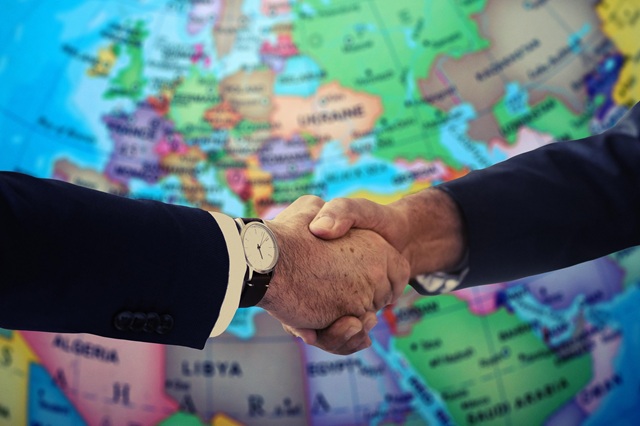
It is tempting to think of diplomacy and war as opposites: diplomacy is what happens when force is absent, and war begins when diplomacy fails. History suggests a different picture. Diplomacy does not stop when the first shot is fired; it changes its purpose. Instead of preventing war, it builds coalitions, shapes the conditions under which fighting continues, manages the risk of catastrophe, and eventually creates the path to peace.
Yet the very thing that makes war possible, the construction of the other side as an “enemy,” also makes this diplomacy harder. The image of the enemy is a tool for mobilizing societies, but it is also a constraint on the leaders who must one day negotiate with the people it describes. This is what happened in the Russo-Ukrainian War with the European Union. Its leaders continue to boycott any official direct contact with Vladimir Putin’s government and with the Russian president himself. In the beginning of the war, it was perhaps a good symbolic gesture. Is it now?
In recent steps, the US administration shocked the world with a new deal with Russia about exports of Russian diesel into the USA. In short, Trump decided to significantly pause sanctions against Russia. The deal was not discussed with European leaders, and its rationale is clear: it has nothing in common with European economic or security interests. At the same time, it has become even clearer that the Trump administration is growing increasingly tired of the Russian-Ukrainian conflict, which brings no clear strategic result. Russia keeps fighting; the regime does not crumble under the pressure; more people die, while escalation risk only grows.
In this context, two European leaders, the Finnish president and the Norwegian prime minister, initiated a direct call with Russian president Vladimir Putin. In other words, they have broken the consensus of “not talking with Russia” (and Putin). And they got criticised for it. But in fact, not talking with the enemy during a conflict is rare and risky business that does not match the history of modern diplomacy.
Functions of wartime diplomacy
So what have been the key functions of wartime diplomacy in the past? Here are some random examples. First, wartime diplomacy builds coalitions: alliance cohesion often matters more than any state’s strength. Britain financed successive coalitions against France during the Napoleonic Wars; the Treaty of Chaumont (1814) committed allies to Napoleon’s defeat after earlier alliances collapsed through separate peace treaties. In the Second World War, Roosevelt, Churchill, and Stalin coordinated strategy and the postwar order at Tehran, Yalta, and Potsdam; despite divergent aims, their alliance lasted until Germany surrendered. In the Gulf War (1990–91), a broad UN-authorized coalition, including Arab states, legitimised the campaign and shared its costs.
Second, diplomacy courts neutrals and isolates adversaries. The secret Treaty of London (1915) brought Italy into the First World War by promising territory; partial non-fulfilment fuelled bitterness at Versailles. Germany’s Zimmermann Telegram (1917), proposing an alliance with Mexico, was intercepted by British intelligence and helped turn American opinion toward war, showing how exposed diplomacy can backfire. The Molotov–Ribbentrop Pact (1939) initially spared Germany a two-front war, but carried unforeseen long-term costs.
Third, diplomacy manages crises through private bargaining when mobilization and public rhetoric limit flexibility. During the Cuban Missile Crisis (1962), Kennedy and Khrushchev exchanged letters while Robert Kennedy met secretly with the Soviet ambassador. The public demand concerned Soviet missiles in Cuba; the private understanding also addressed American missiles in Turkey, allowing both leaders to claim success. The resulting Washington–Moscow hotline reflected the need for reliable contact during crises.
Fourth, and perhaps most importantly, diplomacy continues alongside fighting. Talks in Münster and Osnabrück leading to the Peace of Westphalia (1648) lasted years as military campaigns shaped bargaining positions. This was possible even when one of the core reasons of the conflict were religious (and thus, value based). Korean armistice talks began in 1951 and continued for two years amid heavy fighting, partly over prisoner repatriation. The Paris talks on Vietnam were prolonged by disputes over participation, domestic politics, and military pressure. In each case, battlefield and negotiating table formed one contest pursued by different means.
Finally, intermediaries enable contact when belligerents cannot communicate directly. Thus, diplomacy can have mediating role. US. president Theodore Roosevelt mediated the Russo-Japanese peace at Portsmouth (1905). Henry Kissinger’s shuttle diplomacy after the Yom Kippur War (1973) secured disengagement agreements that helped prepare the ground for Camp David. Humanitarian intermediaries, especially the International Committee of the Red Cross, facilitate prisoner exchanges and monitor the Geneva Conventions.
The paradox of the enemy
Wartime diplomacy rests on a paradox: declaring an enemy withdraws trust, legitimacy, and often recognition, yet states must still communicate, limit damage, and end the conflict. Diplomacy manages this tension. At least, it used to.
Breaking relations need not end communication. Even when embassies close and diplomats are expelled, protecting powers—neutral states representing each side’s interests and relaying messages—maintain contact. Politically costly contact often relies on secret, deniable channels. Kissinger’s 1971 Beijing trip, arranged through Pakistan, reversed two decades of US–Chinese hostility, aided by shared concern about the Soviet Union and Nixon’s anticommunist credentials. The 1993 Oslo channel let Israeli and PLO representatives explore ideas in Norway before the talks were acknowledged. Quiet British–republican contacts preceded Northern Ireland’s 1998 Good Friday Agreement despite the official refusal to negotiate with terrorists. Secrecy lets adversaries test each other’s intentions and develop publicly defensible agreements. But exposure can damage credibility more than contact helps, as the Zimmermann Telegram and the Sixtus Affair of 1917 showed.
Adversaries can cooperate on shared interests without ending their rivalry. During the Cold War, the United States and the Soviet Union negotiated SALT, the ABM Treaty, and later START, alongside the hotline and agreements on incidents at sea. Verification, not trust, made cooperation possible. Military deconfliction channels and humanitarian arrangements such as prisoner exchanges follow the same logic: both sides seek to avoid accidents and protect people held by the other.
The enemy image and dehumanisation risks
Why is diplomacy with enemies often delayed, resisted, or abandoned? Governments mobilise populations for wartime sacrifice by portraying adversaries as threats, aggressors, and moral villains. This enemy image helps sustain fighting but undermines negotiation. In other words, the enemy image is a clear instrument of sustaining the war.
In terms of diplomatic negotiations, portraying enemies as illegitimate makes contact look like weakness, betrayal, or a reward for aggression. Britain’s public refusal to negotiate with terrorists in Northern Ireland, despite maintaining a backchannel, shows the gap between public posture and private practice—and the political effort needed to conceal contact. Similarly, the United States withheld recognition of the People’s Republic of China for over two decades to deny it legitimacy but also deprived itself of normal diplomatic access to a major power.
Depicting enemies as evil makes total victory (and total defeat) seem the only acceptable outcome, narrowing room for compromise. Unconditional surrender illustrates this: defenders say it preserved Allied unity and avoided the ambiguity after 1918, when many Germans believed their army had not truly been defeated. Critics say it discouraged surrender and prolonged war. Either way, the demand shows how the enemy image can restrict possible settlements. In the nuclear age, unconditional surrender is highly risky.
There is a psychological consequence: dehumanisation undermines trust in promises. Diplomacy offers the losing side security, a postwar role, and a future in exchange for ending hostilities. Dehumanised opponents may doubt these promises; if surrender seems to mean destruction, continued fighting can appear rational even when defeat is inevitable. Dehumanisation also hardens domestic opinion. Leaders pay political “audience costs” for retreating from public commitments, and harsher rhetoric raises those costs. Populations taught to see opponents as less than human struggle to accept them as negotiating partners, neighbours, or signatories. The enemy image also intensifies the security dilemma: each side sees the other’s defensive measures as threats and ambiguous signals as proof of hostility.
Is it time to talk with Russia?
History shows that wartime diplomacy rarely stops; it shifts to protecting powers, backchannels, mediators, and narrow agreements, and it works best when the adversary remains recognisable as a party with whom a deal is conceivable. Most EU governments’ public reluctance to talk directly with Putin sits uneasily within that pattern.
The reluctance reflects the enemy-image dynamic described earlier: after years of invasion and attacks on civilians, direct contact risks looking like a reward for aggression, and leaders who have staked out a hard line face the audience costs that make reversal politically expensive. Some of it is also strategy, based on assumptions about what the Russian side does not want. Several governments argue that Putin is not yet interested in real peace talks, so more pressure is needed to change his calculus. There is a catch. The war can escalate as a worst-case scenario, or it can bring unfavourable results not for Russia as it is assumed, but for Ukraine. In that case, Putin’s calculus will be impossible to change, and negotiations will reflect it.
The EU clearly lives in the shadow of the Munich Agreement in 1938, which did not stop the war and only encouraged Hitler in his expansionist policies. But to learn a lesson from one conflict does not mean to manage the other conflict. History shows that the risk lies in the absence of any channel rather than in contact itself: the Cuban Missile Crisis, Oslo, and the opening to China all depended on private lines that existed before a public deal was possible. The EU’s present position, split between outreach by some leaders and abstention by others, resembles a gradual and contested return toward the managed contact that earlier adversaries eventually accepted, with the unresolved question being whether Europe builds that channel on its own terms or leaves it to others to build for it.
On the other hand, the public image can differ sharply from the realities of hidden diplomacy. The EU and member states still have open and functioning embassies in Russia, even when their work is limited. But even so the EU and Russia still have open a normal diplomatic channeles. It is good to keep this in mind when evaluating the overall situation. Likely, the official rhetoric is not meeting the reality which stays rather hidden.
There is always a lesson to be learned. Even in times of huge and seemingly implacable conflicts, diplomacy in some form continued. Automatically excluding any kind of negotiation doesn’t make sense. That doesn’t mean compromise comes easily, but it can help de-escalate and manage obviously high risks. There is also a huge danger in using images of the enemy – this is a mechanism of keeping war ongoing. It uses dehumanising and essentialist language which has nothing in common with European values of liberalism and human rights. The EU and its leaders should temper the use of this dangeour mechanism of mobilisation and militarisation since it dangerously limits their manouvre space.
For the EU, the Russo-Ukrainian war is a conflict in its neighbourhood and, in a way, a war about Europe’s future character and, most likely, about Europe’s position in a rapidly changing world. Not being involved in negotiations and leaving space for Trump and Putin is very risky.
Diplomacy was never just about talking only with friends about things everyone agrees on. On the opposite.