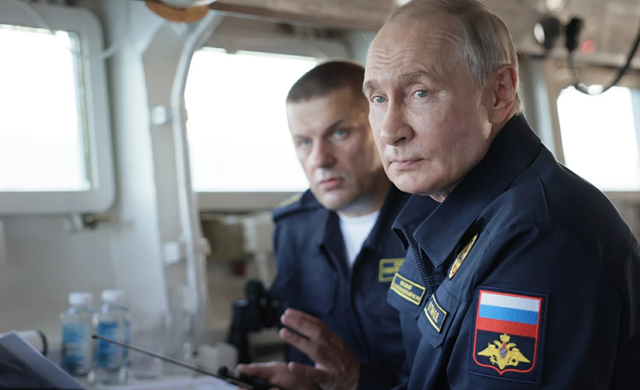
Reports of Putin being in a bunker illustrate how unverifiable intelligence can, through media repetition, be transformed into a seemingly solid political fact or a basis for analysis.
In recent months, claims have repeatedly appeared in the media that Russian President Vladimir Putin is spending an increasing amount of his time in underground bunkers and secure facilities. In some articles, this claim has gradually evolved into the assertion that Putin “hardly ever leaves the bunkers” or that he “spends most of his time” there. However, an analysis of available sources from the past year shows that such a categorically worded conclusion is not sufficiently supported by publicly available evidence. On closer inspection, it also becomes apparent that such reports have limited relevance given the functioning of the Russian political system.
But how do such reports actually spread and become ‘facts’ for the media and for analysts, who should always prioritise verifying the credibility of their sources? A whole host of claims about what is supposedly happening in the Kremlin today appear repeatedly in the Western media – among the perennial favourites are ‘reliable’ reports of Putin’s terminal illness. In this analysis, I will focus on the claim that Vladimir Putin is currently living in fear (mostly) in bunkers.
One main source: many media articles
A key moment in this media narrative can be considered to be 4 May 2026, when the Russian independent (opposition) investigative media outlet Important Stories (iStories) published information contained in an alleged document from a European intelligence service. According to this document, due to heightened security concerns, Putin is using modernised underground facilities and, in some cases, can work there for several weeks at a time.
According to iStories, the document was said to have come from a source close to a European intelligence service. The editorial team also stated that it had been able to verify some of the information independently. The claim itself regarding Putin’s stay in the bunkers was not corroborated by independent evidence. During the same period, CNN and the Financial Times also reported on this topic. Both media outlets drew on information from European intelligence circles, whilst the Financial Times is also said to have used its own anonymous sources familiar with developments in Moscow.
At first glance, therefore, the impression is one of several independent confirmations. Upon closer examination, however, it becomes apparent that a significant portion of the media coverage has a common source: a single leaked intelligence document and several sources who had access to it.
What the original intelligence report actually states
The difference between the original claim and its subsequent media interpretation is fundamental. This is not the first time that a single conjecture has sparked a media frenzy, helping to turn that conjecture or speculation into fact. According to available descriptions of the alleged intelligence document, Putin takes refuge in modernised underground shelters, primarily in the Krasnodar Krai, and can work in these facilities for extended periods.
From the original information, the only thing that can be deduced with relative certainty is that, according to an unnamed European intelligence service, Putin makes use of protected underground facilities; at certain times he may stay there for extended periods; his security arrangements are said to have been tightened; and his movements and public appearances have been significantly more restricted at certain times. However, this does not mean that Putin spends most of his time in the bunkers or even lives there.
Media amplification of the original information
Further developments regarding the spread of this report illustrate a typical mechanism whereby news information is gradually transformed into a more media-friendly claim. The original phrasing, such as ‘may spend weeks in an underground facility’, appears in subsequent articles as: ‘Putin is hiding in bunkers’, ‘Putin hardly ever leaves his bunkers’, ‘Putin spends most of his time in bunkers’ or even as the more general claim that ‘Putin lives in a bunker’.
The difference, of course, is not merely stylistic. Each subsequent step increases the degree of certainty implied by the claim. The repetition and uptake of a single report by various mainstream media outlets create the impression that it is a reliable fact. And that we therefore know what the Russian president’s daily routine looks like.
Another problem with this claim is a shift in interpretation. Life in a bunker and isolation do not mean the same thing. A look at the Russian president’s schedule in recent months has shown a significant decline in Putin’s travels within Russia and his visits abroad. In the first half of 2026, his public movements outside the main presidential residence were significantly restricted. Still, the situation has been changing in recent weeks in view of the upcoming elections in mid-September. In June, he was in St Petersburg and Kazan. In July, he was in Omsk and St Petersburg; at the start of August, he travelled to Krasnoyarsk, then to Buryatia and the Novosibirsk Region.
This trend is significant and can be tracked through publicly available data on the presidential schedule. It does not, therefore, rely solely on an anonymous news source. This recent information on the President’s schedule supports the theory of the President’s greater isolation from the public. Public isolation – that is, reduced participation in public events, visits and trips within Russia and abroad – does not automatically imply political isolation. In this case, it is necessary to distinguish between public appearances and visits that serve the president’s public relations but say nothing about the Russian leader’s political isolation. Another example is the restriction on foreign travel, which has a diplomatic dimension and reflects Russia’s foreign policy.
Why is it important to trace the source chain?
The story about Putin’s bunkers is an example of a wider problem with dealing with anonymous intelligence information. The media chain can be simplified as follows: an unnamed European intelligence service → a leaked intelligence document → the news website Important Stories → CNN/Financial Times and other international media → ČTK and the Czech media → social media and comments.
At each stage, there may be a slight shift in meaning. The original information, ‘he may be working in an underground facility for several weeks’, can thus become ‘he spends most of his time in a bunker’. This mechanism creates a false impression of accumulating evidence. The reader sees ten or twenty articles, but their factual basis may in reality be very narrow. At the same time, there is a telling tendency to accept news reports as fully-fledged facts with direct evidential value. A news report claims that Putin is living in a bunker – therefore, Putin is living in a bunker. After all, any leaked reports from organisations that, by their very nature, operate in secrecy are suspect. This should raise the question: why did the leak occur? What is the aim behind it? The media’s approach was not to ask this question, but to treat the leaked document as factual information.
Yet the leak of such information could have meant a whole range of things; It could have been an individual leak, but it could also have been an attempt to exert psychological pressure on the Russian side (we know where Putin is and we know his regime – a signal of the West’s access to the Kremlin) or it could have been an attempt to influence public debate and support a specific political line towards Russia (we know that Putin is afraid). It could also have been an attempt to provoke and test a Russian reaction.
Physical isolation proves nothing
But let us now return to the report itself – the information about Putin’s isolation. The most solid part of the story about Putin in a bunker is the observable decline in Putin’s travels and public activities, for which, however, no one needs a leaked report from an unnamed intelligence service. All one needs to do is visit the Kremlin’s website and draw a basic statistical conclusion from the data, which can be compared with the period a year or two ago, or before the war in Ukraine and the Covid-19 pandemic (when Putin also kept out of the public eye). There may be various reasons for this: security-related (the US attack on Iran and the assassination of Khamenei, or the kidnapping of the Venezuelan president, may play a role here), personal (with age, Putin is becoming more comfortable and far less active than in the past), and possibly others.
From the perspective of assessing the Russian political system, these reports do not reveal much about whether Vladimir Putin is politically isolated, i.e. whether he lacks sufficient contact with reality and does not have access to relevant information. It is precisely the extent and nature of this political isolation that would constitute relevant information for assessing the state of governance in Russia.
In this case, it would be necessary to look, first and foremost, at who has direct access to Putin, how he communicates with security and political institutions, and, where applicable, who plays a decisive role in the event of the President’s absence. Only then is it possible to conclude whether physical isolation (whether short-term or long-term) also implies political isolation. The media do not ask such questions; instead, they tell a simplified story about Putin in a bunker. And, unsurprisingly, the intelligence services remain silent on the matter. The story of Putin’s bunkers is thus yet another example of how poorly the media operate and how deeply they have become part of – and a tool in – the conflict between the West and Russia.