Elections in a context of war and electoral authoritarianism. How to read them?
Executive Summary
The parliamentary elections in Russia held on 18–20 September 2026 confirmed the fundamental parameters of the current Russian political system: the dominant position of United Russia, the continued existence of a limited systemic opposition, and, at the same time, a further narrowing of the space for political competition outside the framework accepted by the regime, which currently finds itself in a protracted conflict.
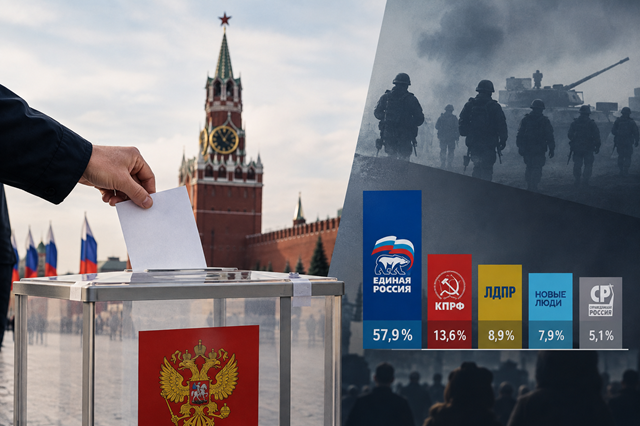
United Russia secured approximately 57.9 per cent of the vote on the federal list. The Communist Party of the Russian Federation (KPRF) secured approximately 13.6 per cent, the Liberal Democratic Party of Russia (LDPR) 8.9 per cent, New People 7.9 per cent and A Just Russia 5.1 per cent. The result does not signify a fundamental shift in the balance of party power but confirms the ruling party’s continuing hegemony.
However, the significance of the elections lies not solely in the results. The elections have highlighted the ongoing transformation of Russian electoral authoritarianism. Political competition is institutionally preserved, but its boundaries are being defined ever more clearly by administrative, legal and judicial mechanisms. The case of Yabloko shows that it is primarily political positions which openly challenge the current political and military framework that fall outside these boundaries.
The war in Ukraine therefore influenced this year’s elections primarily indirectly, through its broader context. It did not become the subject of open political competition, but rather a condition that structurally transformed that competition. It is therefore not possible to infer the level of support for the continuation of the war from the election results. The elections primarily measure support for political forces that were given the opportunity to stand as candidates within a defined system and space, which has essentially been gradually shrinking since 2021.
Key Findings
1. United Russia has retained its dominant position.
The election results did not bring about a fundamental realignment of parliamentary forces. United Russia retained its constitutional majority and control over the vast majority of single-member constituencies.
2. Political competition exists, but its scope is narrowing further.
The elections cannot be reduced to a purely formal process. At the same time, however, it is not possible to analyse their outcome without taking into account which political forces were excluded from the federal contest or whose candidates faced obstacles.
3. The war has become the boundary of political acceptability.
No significant political force that openly rejected or criticised the war stood as a candidate at the federal level. The conflict was thus not an election issue in the usual sense, but rather the structural framework of the electoral contest.
4. The election result is not an indicator of support for the war.
The absence of an open anti-war alternative means that the results cannot be interpreted as a referendum on the continuation of the conflict.
5. The electoral process is becoming increasingly digitised and institutionalised.
The three-day voting period and the more widespread use of electronic voting are changing the conditions of electoral mobilisation whilst simultaneously complicating direct comparisons of voter turnout with previous electoral cycles.
6. The Russian state has sufficient capacity to organise and control a large-scale electoral process even in the current context.
Elections took place in Russia despite growing economic problems and cyber and drone attacks.
1. Electoral authoritarianism: why elections still matter
Russia can be characterised as an electoral authoritarianism, in which authoritarian mechanisms of governance are combined with institutional elements of elections.
From the perspective of the regime’s functioning, elections are not primarily a mechanism for the alternation of power. However, they fulfil several other functions: they institutionalise political power, provide a picture of its social support, enable the monitoring of public sentiment, and create a mechanism for identifying potential political and social tensions.
This framework is important for interpreting this year’s results. The election result cannot be regarded as a direct reflection of the overall political preferences of Russian society. At the same time, it would be analytically problematic to regard the electoral process as entirely insignificant.
The relevant question is therefore not merely ‘who won how many votes’, but also ‘what political preferences could actually be articulated in the elections’.
2. The narrowing of the boundaries of political competition
The most striking indicator of a further restriction on competition is the case of Yabloko, which was the most outspoken in its criticism of the Russia-Ukraine war and thus crossed the line of what was deemed acceptable.
The party’s federal list was initially registered by the Central Electoral Commission, but the Supreme Court subsequently annulled its registration. The formal grounds cited included, amongst other things, foreign funding, the use of material from restricted platforms, and copyright issues.
Yabloko was not completely excluded from the elections. Its candidates were able to stand in some single-member constituencies, and the party also succeeded in the Novgorod region, where it secured 6.3 per cent of the vote and entered the regional parliament. In single-member constituencies, its candidates achieved approximately 10–15 per cent of the vote in some Moscow districts.
The political significance of this case lies primarily in the fact that it highlights the limits of federal political competition. Yabloko is one of the few political forces that has long been openly critical of the war. Its absence from the federal candidate list therefore means that the anti-war stance did not have adequate party representation in this year’s elections.
The restrictions also affected KPRF candidates. At least eight Communist candidates were excluded from the elections to the State Duma or regional parliaments. The most high-profile case was that of Nikolai Bondarenko.
These cases demonstrate that the boundaries of political competition are not defined solely by direct bans on political parties. They also arise through a combination of electoral rules, administrative decisions and judicial mechanisms.
3. Results: continuity rather than political realignment
The election results confirm the continuing dominance of United Russia:
United Russia 59 %
KPRF 13.6%
LDPR 9 %
New People 7.9 %
Fair Russia 5.4 %
United Russia won 208 of the 225 single-member constituencies and retains its constitutional majority. The other parties won the remaining 17 seats (the Communist Party of the Russian Federation 4–5 seats, Fair Russia 4, independents 4, the Liberal Democratic Party of Russia 2 seats and the Rodina party 1 seat).
The KPRF remains the second-strongest parliamentary party, though its result marks a decline compared with the previous election. The LDPR and New People, by contrast, saw a slight increase in support. A Just Russia exceeded the five per cent threshold and retained its parliamentary representation.
From the perspective of the overall balance of power, therefore, the elections did not bring about any fundamental change. More important than any shifts between the mainstream parties is the fact that the fundamental asymmetry between the dominant party and the other political actors remains intact.
4. War as a structural framework for the elections
The war influenced the elections primarily by altering the very conditions of political competition.
These were the first parliamentary elections since the full-scale invasion began in 2022. The conflict therefore represented a significant factor in defining the boundary between politically acceptable and unacceptable positions.
At the same time, the war became part of the framework legitimising the elections. President Vladimir Putin linked voter turnout to support for Russian soldiers and national unity. United Russia also capitalised on the growing political visibility of war veterans in its campaign.
According to the Russian Electoral Commission, nearly 200 people who had fought in Ukraine took part in the elections. Forty-nine veterans will sit in the Duma for United Russia.
This trend has a dual significance. On a political level, it represents the integration of veterans into the new political and social elite. On a social level, it may serve as a mechanism for their reintegration into society and, at the same time, as a way of incorporating their experience into the regime’s institutional framework.
5. Voter turnout and changes to the electoral system
Official voter turnout stood at approximately 59 per cent, compared with 51.72 per cent in 2021.
However, a direct comparison is complicated by changes to the electoral system. Voting took place over three days, and electronic voting played a significant role. According to official figures, approximately 3.5 million voters used this method, primarily in Moscow.
From the regime’s perspective, the higher turnout is significant primarily as part of the elections’ legitimising function. At the same time, however, turnout alone cannot be interpreted as a direct indicator of political support. Voter mobilisation may reflect a combination of political preferences, institutional incentives and other mechanisms of participation.
6. The regime was able to organise and control the electoral process with relative success.
Despite the relatively unfavourable conditions associated with the escalating drone war on Russian territory and the disruption of Russian infrastructure, the elections took place without major problems. This is one of the key findings of the elections, as it demonstrates the regime’s ability to mobilise political and other resources to achieve a predetermined outcome.
The analytical significance of the elections
This year’s elections highlight three interlinked processes.
Firstly, the regime’s continuing institutional dominance.
United Russia controls the parliamentary majority and the fundamental balance of political power remains unchanged.
Secondly, the continuing differentiation between the systemic and non-systemic opposition.
The systemic opposition has scope for political representation in parliament. Positions that significantly exceed the limits of competition accepted by the regime face substantially higher institutional barriers.
Thirdly, the growing significance of the war as a structural factor in Russian politics.
War is not merely a foreign policy issue. It shapes the nature of political competition, the regime’s legitimising framework and the social composition of the political elite.
At the same time, however, the election results cannot be interpreted as a direct measure of public support for the war. The conflict has been largely excluded from political competition precisely because it has become one of the conditions defining the boundaries of permissible political competition.
Implications for futher analysis
Four areas in particular will be relevant for monitoring developments in the Russian political system following the elections:
1. The social costs of the war
An important indicator will be not only declared support for the war, but also the evolution of attitudes towards its economic and social costs. Under current conditions, only fragmentary information on this can be obtained.
2. The relationship between mobilisation and political control
Higher voter turnout does not in itself imply greater political support for the regime. It will be important to monitor the mechanisms that generate and sustain this turnout.
3. The integration of war veterans
The growing representation of veterans in political institutions may represent a significant factor in the future development of the Russian elite. At present, however, this representation is limited and has its constraints.
4. The limits of systemic opposition
The development of Yabloko, the KPRF and other opposition actors will reveal whether the scope for limited political competition will continue to narrow, or whether the regime will allow some social conflicts to remain within the institutional system or suppress them through bans.
Final assessment
This year’s parliamentary elections do not represent a fundamental shift in the balance of political power in Russia. Their significance lies rather in confirming the way in which the Russian political system functions under conditions of ongoing war.
The elections continue to provide the regime with institutional legitimacy, enable the mobilisation of society and, at the same time, create a limited space for political expression. However, this space is not neutral: its boundaries are increasingly defined by the context of the war.
The key question for future developments is therefore not merely the stability of United Russia’s dominance. It will be more important to observe how, in the long term, the system manages to combine political control, the mobilisation of society and the absorption of the social costs of the war. It is precisely here that the political significance of the elections – which, at first glance, have primarily brought continuity – will be determined.
Veronika Sušová-Salminen